Behind every safe and efficient industrial operation, there is an inspection process ensuring that materials, welded joints, and equipment remain in optimal condition. In industries such as oil & gas, energy, manufacturing, construction, and renewable energy, undetected defects can develop into major operational and safety risks.
To address these challenges, industries require inspection methods capable of identifying potential failures without damaging the inspected object. One of the most reliable technologies widely used today is Non Destructive Testing (NDT).
Understanding Non Destructive Testing (NDT)
Non Destructive Testing (NDT) is an inspection method used to evaluate the condition of materials and industrial equipment without causing damage to the tested object. This technology enables the detection of internal and surface defects that are difficult to identify through visual inspection alone.
NDT methods are commonly used to inspect:
- Welded joints;
- Pipelines;
- Tanks and pressure vessels;
- Steel structures;
- Heat exchangers;
- Industrial production equipment and installations.
With the advancement of inspection technology, NDT has become an essential part of asset integrity management across modern industries.
Why Industries Need NDT
Over time, industrial materials and equipment may deteriorate due to pressure, high temperatures, corrosion, vibration, and harsh operating environments. Without regular inspection, these conditions may result in:
- Leakage;
- Weld cracking;
- Equipment performance degradation;
- Operational disruption;
- Workplace accidents.
Through NDT, potential failures can be identified at an early stage, allowing industries to implement preventive actions before more serious damage occurs.
In addition to improving safety, NDT also helps industries:
- Reduce operational downtime;
- Optimize maintenance costs;
- Extend equipment lifespan;
- Support compliance with industrial standards and regulations;
- Improve operational efficiency and sustainability.
Commonly Used NDT Technologies
Today, various Non Destructive Testing methods are applied depending on inspection requirements and material characteristics.
1. Ultrasonic Testing (UT)
Ultrasonic Testing uses ultrasonic waves to detect internal defects in materials and welded joints.
This method is commonly used for:
- Thickness measurement;
- Flaw detection of materials;
- Flaw detection on weld joints;
- Detection of cracks, porosity, and lamination.
2. Magnetic Particle Inspection (MPI)
MPI is used to identify surface and sub-surface defects in ferromagnetic materials.
The advantages of this method include:
- Surface crack detection;
- Sub-surface crack detection;
- Effective inspection for weld joints and metal structures.
3. Dye Penetrant Testing (PT)
This method utilizes specialized penetrant liquids to identify surface flaws and cracks.
It is commonly applied for:
- Surface flaw detection;
- Detection of small cracks;
- Inspection of metal components and welding results.
4. Eddy Current Testing (ECT)
ECT applies electromagnetic principles to detect defects in conductive materials.
This method is commonly used for:
- Tube corrosion detection;
- Erosion and crack detection;
- Sub-surface crack inspection in heat exchangers and piping systems.
The Role of NDT in Industrial Reliability
As industries continue to prioritize safety, efficiency, and sustainability, NDT plays an increasingly strategic role.
The implementation of NDT helps industries to:
- Understand the actual condition of materials and equipment;
- Minimize operational failure risks;
- Support preventive maintenance programs;
- Provide technical evaluation and feasibility analysis;
- Support certification and industrial compliance processes.
Fast, accurate, and minimally disruptive inspections make NDT a critical solution for various industrial sectors.
SUCOFINDO Supports Industrial NDT Requirements
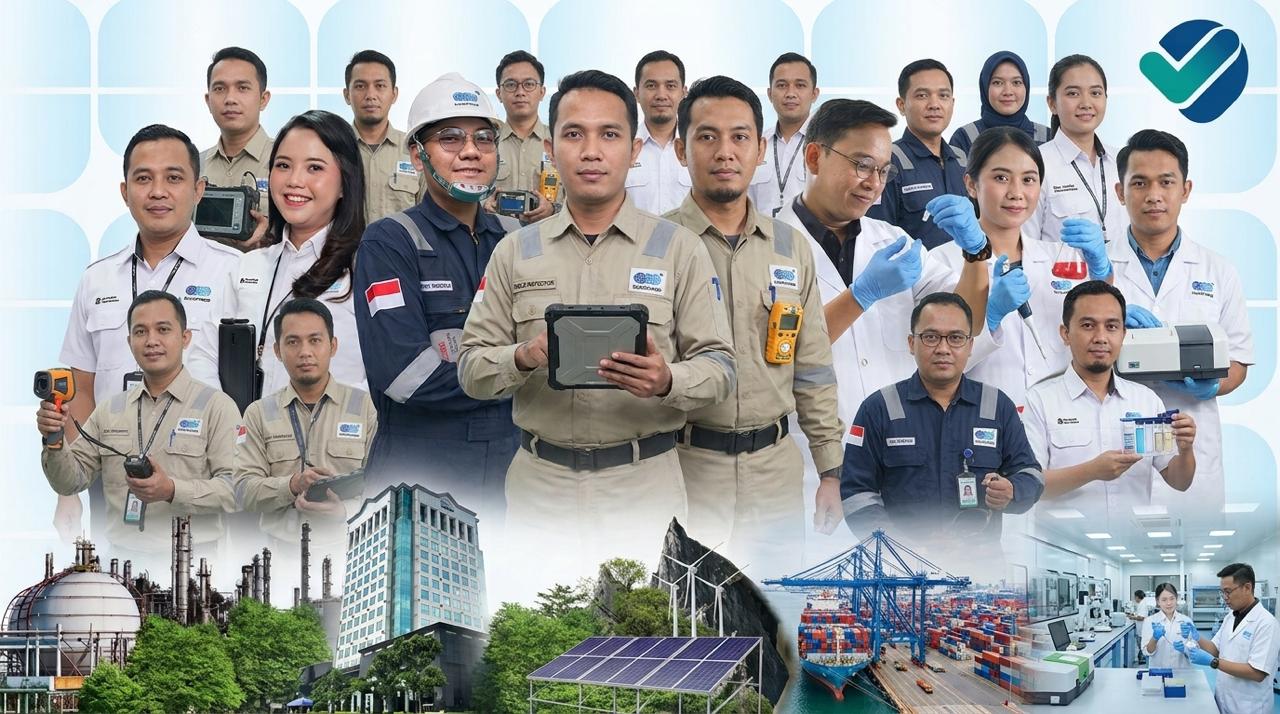
As a trusted inspection, testing, and certification company, PT SUCOFINDO (PERSERO) provides Non Destructive Testing services to support various industrial sectors in Indonesia.
The advantages of SUCOFINDO’s NDT services include:
- Supported by qualified and experienced experts;
- Reliable inspection equipment and technology;
- Nationwide service network across Indonesia;
- Inspection processes based on national and international standards;
- Accredited to ISO/IEC 17020 and ISO/IEC 17025;
- ISO 9001 certified quality management system;
- Customized solutions tailored to client requirements.
SUCOFINDO’s NDT services cover technical document review, field inspection, material and weld testing, technical evaluation, and inspection reporting.
Non Destructive Testing (NDT) is not only an inspection method but also an essential part of maintaining safety, asset reliability, and sustainable industrial operations.
By detecting potential failures without damaging the inspected object, NDT helps industries operate in a more:
- Safe;
- Efficient;
- Reliable;
- Sustainable manner.
Through professional inspection services and internationally recognized standards, PT SUCOFINDO (PERSERO) is ready to become a trusted partner for industrial NDT solutions across Indonesia.